Lovely Old Tree has finally moved to its own domain name – lovelyoldtree.com. If you are a subscriber, please go to the new website and subscribe again to see the latest posts. This site will be around for a while yet, but there will be no new posts published here, so please head on over to lovelyoldtree.com now!
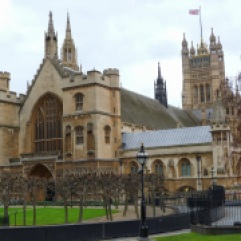
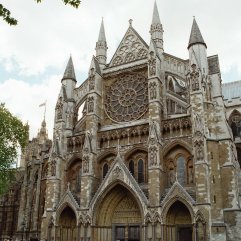
The complex of buildings found at Westminster is a little architecturally confusing. We have Westminster Abbey, clearly old from what you see inside it, Westminster Hall and the Palace of Westminster, which look similar, and Big Ben, which screams Victoriana. These buildings can easily blend together if you don’t look carefully and that blending was indeed the intention of the designers.
It’s pretty shocking that in 1834, not that long ago, we lost an enormous historical palace at Westminster which consisted of amazing medieval and early modern buildings. This ‘Old Palace’ was destroyed by a terrible fire and the only surviving buildings are the Cloisters of St Stephen’s, the Chapel of St Mary Undercroft, the Jewel Tower and most notably Westminster Hall.
Illustration of the Old Palace of Westminster in the reign of Henry VIII – Henry William Brewer, 1884
The Westminster site was used as a residence for Kings of England since the 11th century and much was built and extended over the course of the next 500 years. The oldest part we can still see is Westminster Hall, which was built by William II. In 1295, the Model Parliament met at Westminster, beginning the tradition for all future parliaments of England.
Because the palace was not designed for intensive parliamentary use, drastic alterations were made to it between the 16th and 19th centuries. The palace must have looked a little dilapidated and in the 18th century there were calls for a new palace to be built. This clearly coincides with the fall in popularity of the medieval gothic architectural style. People preferred classical styles and Palladian additions were made. Most notable, Sir John Soane demolished the medieval House of Lords chamber and rebuilt it in the neo-classical style.
This period saw a backlash against the neo-classical style and this destruction of medieval buildings. Several key thinkers began to mourn the loss of the older gothic parts of the Palace of Westminster. Some architectural writers appreciated the aesthetics of England’s gothic buildings. Horace Walpole built his gothic house at Strawberry Hill in 1747 and described the style as ‘venerable’ and ‘charming’.
The enthusiasm for the style among architectural writers increased and many illustration collections and studies were published, including the influential Essays on Gothic Architecture by Thomas Warton and others, published in 1800. The cause was taken up by Auguste Pugin, who published Specimens of Gothic Architecture (1821) and Examples of Gothic Architecture (1831).
The fire of 1834 at the Palace of Westminster
The devastating fire at the palace must therefore be seen in this context. The fire was caused by an overheated stove beneath the House of Lords Chamber and raged overnight destroying almost everything. Many people helped fight the fire, preserving some of the buildings, but many watched the fire with glee, seeing it as a punishment for unpopular politicians. If you want to learn more about the fire itself, I recommend a podcast from the House of Commons – listen here.
Architects saw the fire as an opportunity to get rid of the hodgepodge of architectural styles that cluttered up the gothic. After the fire, parliament decided they needed a building more fit for purpose, but that emphasised the governments historical origins. Therefore, a competition was held for architects to redesign the palace in ‘either Gothic or Elizabethan’ style, to lessen the shock of the destruction.
An architectural struggle raged through the nineteenth century between classic and gothic adherents. In 1884 Robert Kerr gave a paper to the General Conference of Architects detailing this ‘architectural civil war’, describing how
at the moment when Barry in his Club-houses offered us a new version of Wren’s Classic, we threw it over and reverted to Gothic; and at the moment when Street in his Law Courts had brought Pugin’s Gothic to a supremacy, we now cast that aside and return to Classic.
In February 1836, Charles Barry’s neo-gothic proposal for the palace was accepted and he employed Augustus Pugin to design the gothic interior. Construction was finally completed in 1870. It was designed to look medieval and fit into the surrounding medieval buildings, while still providing space appropriate for the running of parliament.
I noticed a picture of a baby cage made it into the Metro the other day. It seems that this historical oddity is one that constantly comes in and out of the media and causes incredible public shock and outrage every time. It is amazing how attitudes change, so that something invented in the 1920s to do nothing but good now leaves us struggling to believe it ever happened.
In 1923 Emma Read patented the Portable Baby Cage. It was designed to solve the problem of large high rises in urban areas which left families with no open spaces to allow their young children to play. It was agreed that babies needed fresh air to maintain their health, so the baby cage was a simple and safe way to leave babies outside to enjoy the air. In the patent it is explained that:
It is well known that a great many difficulties rise in raising and properly housing babies and small children in crowded cities, that is to say from the health viewpoint. “With these facts in view, it is the purpose of this invention to provide an article of manufacture for babies and young children, to be suspended upon the exterior of a building adjacent an open window, wherein the baby or young child may be placed.
The cage could be suspended outside an open window of a flat, allowing the baby to sleep or play fully in the open air with wire mesh protecting it from falling. The baby cage was used in London during the 1930s, when in particular they were distributed to members of the Chelsea Baby Club ‘who have no gardens and live at the top of high buildings’, as documented by Getty.
The idea didn’t really catch on for many obvious reasons. Firstly the wire mesh looks awful and must have reminded mothers constantly that they were really locking their baby in a cage: and I’m sure the name didn’t help either. Secondly they look incredibly dangerous, with babies potentially suspended 200 feet from the ground. But you can see how exciting and fun it looks in this British Pathé film from 1953.
The baby cage has since made it into the annals of strange and horrific inventions of the twentieth century. However it’s important to try to see it from the perspective of the inventor, who was just trying to solve a problem. Still, it doesn’t seem likely to make a comeback any time soon!
Yesterday I watched Terry Gilliam’s 1988 film, The Adventures of Baron Munchausen for the first time. It stars John Neville as the Baron and Eric Idle as Berthold. It’s a fantastic film, completely absorbing and surreal with amazing sets, stunts and action which look so impressive compared to today’s CGI alternatives.
With spectacle comes criticism however as, having done some research on the film, it is clear that Gilliam’s films are notorious for being dangerous and traumatic for the cast and expensive to film – watching this one, you can see why. Sarah Polley, who played 9-year-old Sally, said:
It definitely left me with a few scars … It was just so dangerous. There were so many explosions going off so close to me, which is traumatic for a kid whether it’s dangerous or not. Being in freezing cold water for long periods of time and working endless hours. It was physically grueling and unsafe.
There were disputes surrounding the production and in the end it received limited distribution and only made $8 million in the US box office. Nonetheless, I really recommend it as it is so spectacular and engrossing – and it’s currently on Netflix!
The Baron in Terry Gilliam’s The Adventures of Baron Munchausen
It really made me think about the stories that inspired the film and specifically the real Hieronymus Carl Friedrich Baron von Münchhausen. The real Baron was a German nobleman, born in 1720, who became famous for telling stories about his adventures.
Münchhausen moved to Russia where he rose to the rank of Rittmeister (Captain) in the Russian cavalry and fought in the Russo-Turkish War. He was known as a amiable and truthful man, however after he retired he gained a reputation as a teller of extraordinary stories about his time in Russia. He told these tall tales at social gatherings as entertainment and perhaps to poke fun at his contemporaries’ love for rationality. This theme certainly runs through the film as the Baron exclaims he is tired of the world because:
It’s all logic and reason now. Science, progress, laws of hydraulics, laws of social dynamics, laws of this, that, and the other. No place for three-legged cyclops in the South Seas. No place for cucumber trees and oceans of wine. No place for me.
Bearing in mind this relatively simple story of the Baron’s real life, it is amazing that his stories had such far-reaching effects. He began to be fictionalized before he even died, when 17 of his stories made it into the Vademecum fur lustige Leute between 1781 and 1783. In 1785 these were translated into English, as Baron Munchausen’s Narrative of his Marvellous Travels and Campaigns in Russia by Rudolf Erich Raspe, and over the next century his stories were expanded and republished multiple times, becoming very popular.
It is likely that folk and fairy tales made it into the narratives that were attributed to him, so we cannot know how much of the material is really his. He was apparently very annoyed that his name was associated with these tall tales as he was given the name Lügenbaronor Baron of Lies.
Illustration of Baron Münchhausen underwater by Gottfried Franz 1896
Still it was way too late to stop public enthusiasm for the fictionalized Baron and the character and stories were replayed again and again on the stage, on radio, television, in films and even in video games. Some of the most famous stories that were in Raspe’s 1785 book and in Gilliam’s film include the Baron’s journey to the moon in a hot air balloon, his meeting with Venus and his escape after being swallowed by a giant fish.
Lastly, Münchausen Syndrome was named directly after the fictional Baron. In an article published in 1951, British doctor Richard Asher proposed the name Münchausen Syndrome for cases of patients lying about their illnesses, arguing that:
Like the famous Baron von Munchausen, the persons affected have always travelled widely; and their stories, like those attributed to him, are both dramatic and untruthful. Accordingly, the syndrome is respectfully dedicated to the baron, and named after him
He was criticised for this, since other physicians felt the name trivialised the disorder and downplayed the dangers associated with it and also linked it to a real man who did not suffer from the condition. Clearly though the name has stuck and is now in common usage.
Adele Parks is a very successful novelist, whose books have so far been set in the modern day and have followed the lives of different women. She has made her first step into historical fiction with this new novel, Spare Brides, published by Headline this month.
Parks is certainly not the kind of author I would normally read, and so I was a little apprehensive when I was asked to review her new book. The marketing and descriptions I read made me think it might just be another bodice-ripper. However I was pleasantly surprised by Parks’ ability to deal with a historical setting and the book is an absorbing read.
The novel is set in Britain in the aftermath of the First World War, as a group of different women come to terms with the losses they have suffered. The story revolves around Lydia, a beautiful but vain woman who struggles with her marriage, specifically her inability to conceive a child and her husband’s lack of participation in active combat in the war.
Her story is set against three other women: Sarah, whose husband was killed in the war, Beatrice, a single woman who is left with little money or marriage prospects, Cecily, whose husband lost both legs and an arm at Passchendaele, and Ava, a socialite who indulges in the luxuries and vices of the era of the “bright young things”.
Lydia meets a young man, fresh from war, and embarks on an affair that changes the way she thinks about the war and her own happiness. The shock of the affair also alters her friends’ lives as they too reassess the roles they have been left with after the war.
The novel is, above all, a romance. It tells the story of lovers working out how to deal with their relationship when it so profoundly affects those around them. It could therefore be set in any era. However what the post-war setting adds to the narrative is a profound sense of guilt, pity and concern felt by the characters about one another to different degrees. How can one justify uprooting a relationship when so many have had theirs destroyed by war? How does one come to terms with a society in which the roles of men and women are so radically altered? I felt that the creation of this atmosphere was the most successful aspect of Parks’ book.
Nonetheless the love story dominates the narrative so intensely that I felt there were opportunities missed for the exploration of more interesting historical areas. Of course, if you want a romance , this one is certainly very engaging, but it would not be something I would go out of my way to read. There are plenty of elements that mark the narrative out as a standard romance: descriptions of silk garments felt against naked skin, sexual descriptions which I personally find unnecessary and of course the inevitable love-at-first-sight scene. Again I want to make clear that if romance is what you want, this has it all, but personally I consider these kinds of tropes superfluous.
While the historical detail appears to me to be legitimate, there are points where it feels a little clunky: ‘like every fashionable woman she wanted to wear her hair cropped at the ear, as she favoured close-fitting cloche hats’. Some of the characters seem at times a little archetypal: the damaged womanizing war hero and the gorgeous promiscuous flapper. However this problem is corrected over the course of the narrative as the characters gain depth and the stereotypes are questioned.
If you have an interest in the First World War and its social effects at home, and you don’t mind a bit of romance, this novel is worth a read. It does conjure up successfully the atmosphere of the era and deals with some of the key problems faced by women after the war. And if you want a love story set against a thought-provoking and nostalgic historical backdrop, this book is definitely for you.
Spare Brides will be published by Headline on 13th February 2014 and can be found on Amazon.
I went to the V&A’s Museum of Childhood for the first time on Friday. I had always thought it would be interesting to see all the childhood-related objects collected by the Victoria and Albert Museum in one place, but I had never got round to visiting. The objects date from the 1600s to the present day and most of the exhibits are toys, with a section containing objects associated with home life and child upbringing.
The first thing you notice about the museum is its design. It consists of a large open space containing the café and shop, with all of the exhibits positioned around the centre. This makes it a great place to visit with young children as its impossible to get lost. There were many very young children there when I visited and it seemed to me that they were all really enjoying themselves.
Most of the objects on display are in glass cases with some interactive screens and activities and areas for children to play. I saw the kids interacting really well with everything and showing a real interest in the objects. Parents were also walking around showing their children the toys they used to play with when they were young.
As well as the 20th-century nostalgia available, there are plenty of amazing objects from earlier centuries. On one side of the museum, the toys are arranged by the technology behind them – so for example, clockwork, magnets, springs etc. The section for optical toys was interesting as it ranged from nineteenth-century zoetropes to the Megadrive, Xbox and Playstation.
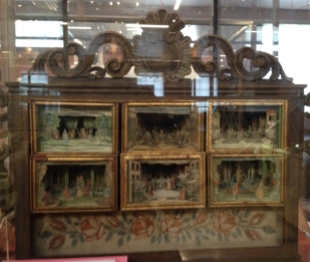
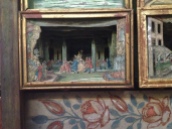
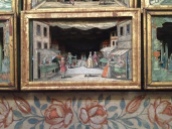
Miniature 3-dimensional theatre, made by children’s illustrator Martin Engelbrecht around 1721
Scene from Engelbrecht theatre
Scene from Engelbrecht theatre
These photographs are of a large 3-dimensional theatre made from layers of card, with different sections showing different scenes. It was made by Martin Engelbrecht in around 1721, who was famous for his illustrations of children’s books. This section also has some good interactive screens which show different toys with videos of how they work and explanations of their mechanisms. They even have x-rays so you can see how the mechanism is arranged inside the toys.
On the other side of the museum, the toys are arranged into categories like soft toys, dolls, building and making etc. They have some wonderful dolls houses and dolls including the first version of the Barbie doll from 1959. Some of the dolls and soft toys were very familiar to me, while others I had never heard of but were apparently very famous.
Soft toys Pip, Squeak and Wilfred with 1939 annual.
For example, above are soft toy versions of Pip, Squeak and Wilfred from the 1930s. These characters were from a long-runningcartoon published in the Daily Mirror from 1919 to 1956. They were devised by Bertram Lamb and drawn until 1939 by Austin Bowen Payne. The cartoon was incredibly popular and successful, spawning dedicated newspaper supplements, annuals like the one pictured above and even in 1921 twenty-five silent animated cartoons.
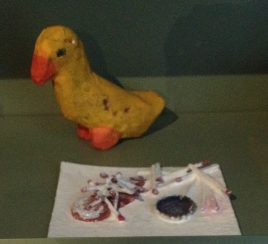
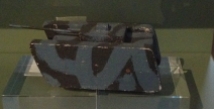
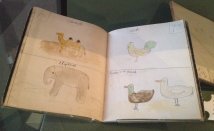
On of my favourite sections is about the history of children making toys and objects of their own, as I was obsessed with craft as a child. Pictured below is a paper mache duck and a campfire made from matches and bottle tops, both made by a three-year-old boy called Stephen, born in 1957. There is also a tank made by an eight-year-old in 1942 and some animal drawings created between 1890 and 1900. Looking at these objects really makes you realise how children from every era are just the same, as it is impossible to tell the difference between a child’s creation from 100 years ago and one today.
Model duck and campfire created in 1960 by a little boy called Stephen at nursery school
Model tank made by Sir Nicholas Goodison when he was 8 years old, in 1942.
Greetings cards made by the Cattley children between 1890 and 1900.
Some other interesting exhibits include dolls from the eighteenth-century to today. You can see how Barbie’s figure developed over the course of the last 50 years, but even more startling is the shape of older dolls, such as the 1720 doll pictured below. Also, while Barbie is usually the doll accused of being damaging to young girls, I was shocked to see how Sindy’s looks have changed since her introduction in 1963. Sindy had always been a child-like doll in relatively casual childish clothing, however her latest incarnations have made her older, wearing more revealing clothing.
The museum also contains sections on the history of the upbringing of young children, with objects relating to washing, feeding and learning. They have a large case showing the development of children’s clothing between the eighteenth century and today.
At the moment they also have an exhibition called War Games, which runs until 9th March 2014. This exhibition shows the various action and strategy war-related games children have played of the years, and also links the history of these toys to the actual history of warfare of the last 100 years. It ends by making the link to science fiction and asking visitors whether they think war-related children’s games are morally right.
The museum is really worth a visit, with children or without, and it isn’t so enormous that you can’t see everything in a few hours. It’s located just down the road from Bethnal Green station and is open every day between 10am and 5.45pm.
Wooden doll made in 1720.
First Barbie doll from 1959.
Luxury toy, 1870-1880. When the handle is turned the monkey musicians perform.
Pull-along rabbit toy, made in Germany between 1928 and 1930.
Beatles magnetic hair toy, 1963-1970.
Wooden duck on wheels, 1912.
Sindy dolls, 1963-2004
Wooden marionette puppets of Saint George and the dragon, made between 1920 and 1930.
I have often walked past Lincoln’s Inn on my way to Chancery Lane and the Maughan Library. Lincoln’s Inn Fields is a beautiful little park to stroll through to avoid the busy roads and it’s amazing how quiet it is once you step away from Kingsway and High Holborn.
There are several interesting places around the square includingSir John Soane’s Museum and the Royal College of Surgeons with its fantasticHunterian Museum. As you walk east towards Chancery Lane, it becomes clear you are in London’s legal centre. You can see several legal institutions including Essex Court Chambers, New Square Chambers and of course the Royal Courts of Justice looming over to your right.
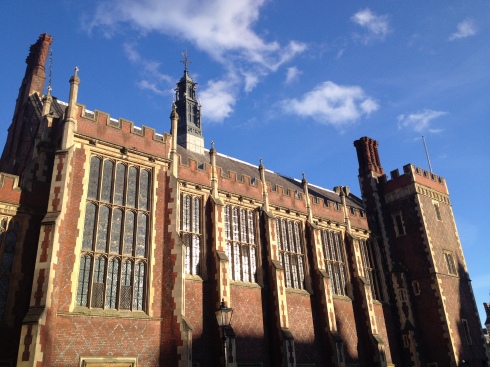
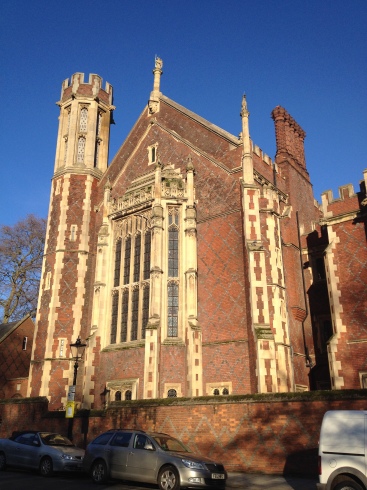
Lincoln’s Inn
The reason that this area is the legal hub of the city is because the original four Inns of Court are situated around this area, Lincoln’s Inn, Middle Temple, Gray’s Inn and Inner Temple. The Inns of Court were societies for the lodging, training and practice of barristers, however today the buildings are used primarily by members as offices.
The Inns were founded between the fourteenth and fifteenth centuries and in the early modern period they became, along with Oxford and Cambridge, a necessary part of any high-status professional’s education. For example, famous members of Lincoln’s Inn include Sir Thomas More and John Donne. Inner Temple counts Sir Francis Drake, Mohandas Ghandi and John and Robert Dudley among its alumni. It is also speculated that Geoffrey Chaucer and Oliver Cromwell were also members of the Inns of Court. From the Lincoln’s Inn website:
First, why “Inn”? As well as applying to the houses used by travellers and pilgrims – the usage that usually comes to mind – the term, or its Latin equivalent hospitium, also applied to the large houses of magnates of all kinds, such as statesmen, bishops, civil servants, and lawyers, whose business brought them to town, especially when Parliament and the courts were in session.
Lincoln’s Inn has some of the most imposing and impressive buildings which can’t be missed when walking through the park. The origins of the Inn are not fully known – the extant records of Lincoln’s Inn open in 1422, but it is thought the Inn was in existence before then. It it also thought that it was named after Henry de Lacy, third Earl of Lincoln who may have been patron.
In the late sixteenth century, Lincoln’s Inn consisted of the Old Hall, some chambers and the chapel. The Old Hall was built “in the fifth year of King Henry VII” and was used as a dining hall and court of justice. The Hall features as a setting for the opening scene of Charles Dickens’ Bleak House.
A new chapel began to be built in 1620 after the original fell into disrepair. John Donne was preacher at the time and not only laid the foundation stone for it, but also led its consecration on Ascension Day in 1623. In the 1880s the chapel was enlarged and the roof rebuilt in the Gothic revival style of the time.
In 1843, the Great Hall was built to relieve the pressure on the smaller Old Hall. Before this new hall was built with a new entrance to the Inn, the main entrance had always been the Gate House on Chancery Lane. The Gate House as built between 1517 and1521 and the present oak doors date from 1564. Since this entrance is no longer in use, it is too easy to walk down Chancery Lane and completely miss this historic site. It was restored in the 1960s and now you can see above the door the arms of Henry de Lacy, Earl of Lincoln; Henry VIII; and Sir Thomas Lovell above a stone recording a 1695 restoration.
The Gate House, Lincoln’s Inn
Lincoln’s Inn still performs all of the functions of an Inn of court, offering education, training and services for lawyers. Its buildings are also historical attractions and function rooms however, so the society offers room hire for functions and weddings and a variety ofguided toursfor tourists. I haven’t yet been on a tour inside the Inn but the areas around the buildings are open for pedestrians to stroll around from Monday to Friday, 7am to 7pm. There are also regular services for the public in the chapel as well as special events.
The new Mary Rose Museum opened this year, and while I haven’t had the chance to visit yet, it’s a good moment to look back at its fantastic history. BBC News broadcast a short documentary about the raising of the ship and the years of conservation work and this one is really worth a watch because you get some great behind-the-scenes access. It’s really made me consider conservation as a career – if I could only go back to uni!
In the first few decades of Henry VIII’s reign, he devoted a great deal of time to building up the English navy from its weak position, in order to enter the global military stage. Henry wished to relive the glorious victories of England’s past by engaging in war with France. He oversaw the construction of several new ships, including the Mary Rose, the Peter Pomegranate and the Henry Grace a Dieu.
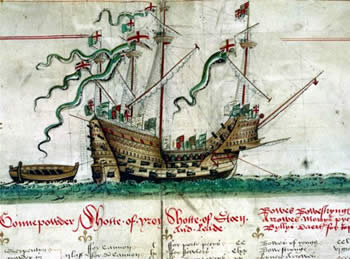
The Mary Rose
The Mary Rose was built in Portsmouth and launched in July 1511. She was built primarily of oak and weighed 500 tons. While it is a common story that she was named after Henry VIII’s sister Mary, historians assert that it is much more likely that the name was based on the Virgin Mary.
Immediately after construction, the ship engaged in battles with the French in the First French War, first in 1512 and then in 1513. In July 1514 she was placed in reserves for maintenance and subsequently took part in the Second French War, before being kept again in reserve from 1522 to 1545.
The last battle of the Mary Rose was the Battle of the Solent against the French in July 1545. The ship was not sunk due to damage, but right at the start of the battle a malfunction caused it to lean heavily to the right, allowing water to enter. This could not be corrected and the ship began to be damaged by water and falling equipment. The Mary Rose sank very quickly, giving men trapped by nets and equipment no time to escape.
In 1985, three years after the ship was salvaged, Patrick Wright wrote about the Mary Rose in his book On Living in an Old Country: The National Past in Contemporary Britain:
The fact that it sank due to what one commentator admits must have been ‘gross mismanagement’ before even engaging with the threatening French fleet does not appear to have prevented this from being recognised as the real stuff of history by the thousands who followed and celebrated the recovery.
Secretary of State William Paget ordered the ship to be salvaged soon after its sinking and while some guns, rigging and other equipment were retrieved, the hull could not be raised. The Mary Rose then lay forgotten on the bottom of the Solent for nearly 300 years until in 1836 it was rediscovered by fisherman.
The Victorian period saw many objects retrieved from the wreck and while some deteriorated due to inadequate preservation techniques, sketches were made of many objects and interest in the Mary Rose grew.
Modern efforts to salvage the ship were instigated by the Southsea branch of the British Sub-Aqua Club in 1965. The Royal Navy and the Committee for Nautical Archaeology in London were also involved in the project. By 1974 the Committee had support from the National Maritime Museum, the Royal Navy, the BBC and Prince Charles.
The wreck was extensively surveyed and more objects retrieved. Plans for the salvage of the surviving section of hull began to be prepared, drawing on lessons from the salvage of the Swedish warship Vasa in the early 1960s. The methods of raising the wreck were highly contested due to fears that it would not hold together out of the water.
The Mary Rose salvage operation
In Spring 1982, the plans began to be put into action. The frame was attached to the hull and slowly eased away from the seabed, before being lifted by a crane onto a specially designed cradle. On 11 October 1982, the full salvage began and the ship broke above the surface at 9.03am. Patrick Wright:
The Mary Rose is raised into the present social imagination, and it makes its entrance from the parallel realm of ‘nature’. It comes into society as if from nowhere.
The notion of the time-capsule situates the Mary Rose in a narrative structure which comes up again and again in various and diverse fables of nationalism.
The conservation process began immediately after the ship reached the surface. The hull and its objects were very sensitive to deterioration after air exposure due to their long rest underwater and so each artefact was immediately stored according to the material it was made of.
The Mary Rose being sprayed with polyethylene glycol
The initial aim of most of the conservation was to ensure that none of the material was allowed to dry out, before more permanent methods of preservation could be achieved. So the hull was constantly sprayed with water and kept at a low temperature. Then between 1994 and 2010, the hull was sprayed with polyethylene glycol, a substance commonly used for preserving old wood. Over the sixteen years, this substance replaced the water in the timbers with wax. Since 2010, the hull has been in a phase of controlled air drying.
The hull was on display to visitors during this process, however it was only visible from behind a glass barrier in a covered dry dock. A separate museum was opened in the 1980s to explain the history of the ship and display artefacts. The new museum opened in May this year, finally uniting the hull with its objects and the history of the ship and its crew.
Efforts have been made to reconstruct the lives and physical attributes of the lost crew members, to make the ship and its era seem more real to the public. Even though only part of the hull remains, the museum reconstructs the other sections to give a better impression of the entire ship. Patrick Wright:
Is the Mary Rose still the Mary Rose? While the actual planks remain the same, there can be little doubt that, like the Ship of Theseus, this is a boat which has been thoroughly remade.
With so much reconstruction necessary and so much of our modern own historical consciousness applied to the Mary Rose, there is some truth in Wright’s words. However he was writing long before this new museum was opened, so I hope that when I visit I will find that his cynicism is proved wrong.




 Adele Parks is a very successful novelist, whose books have so far been set in the modern day and have followed the lives of different women. She has made her first step into historical fiction with this new novel, Spare Brides, published by Headline this month.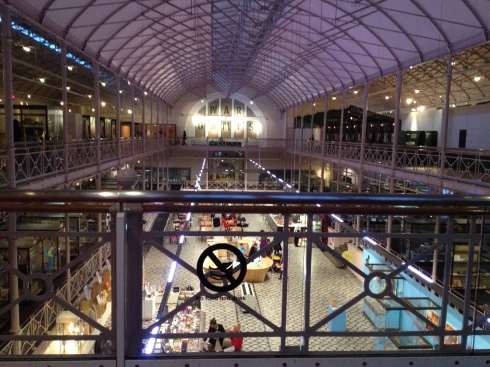






 Lovely Old Tree
Recent Comments